

Effects of dietary combination of astaxanthin and plant extract on cooked shrimp color of black tiger prawn (Penaeus monodon) reared under normal condition and ammonia-N exposure
Waesulong, I.1, Chunwijitra, S.1, Panchimplee, M.1, Taboonpong, K.1, Nuntapong, N.2 and Thonking, P.1*
INTRODUCTION
- Astaxanthin is a orange-red color important carotenoid and one of the most powerful biological antioxidants that occurs naturally in a wide variety of living
- For aquaculture, Astaxanthin can be used to enhance cooked shrimp color. In addition to the benefits in improving the color of shrimp It was found that astaxanthin was used from various sources to improve growth survival rate of larvae and adult shrimp (Chien et 2003).
- Natural extracts have antioxidant properties and reduction of the pro-inflammatory. It can enhance stress, health status, and cooked shrimp color.
- The aim of the study was to determine the effects of astaxanthin and plant extract on cooked shrimp
MATERIAL AND METHODS
The 360 black tiger prawns were divided into 8 treatments (T) 3 replications (n=15) of
each group and categorized into T1-T8.
T1: control no added astaxanthin
T2: Astaxanthin 10% (competitor)
T3: Astaxanthin 10%
T4: Astaxanthin combination with plant extract (AX Booster)
T5: control no added astaxanthin on stress condition
T6: Astaxanthin 10% (competitor) on stress condition
T7: Astaxanthin 10% on stress condition
T8: AX Booster on stress condition
- The astaxanthin was applied into the diet at 100 mg/kg.
- The experiment was carried out in 24 tanks with each of 200 L capacity that
- contained 120 L of 15 ppt saline water, pH 7.5-8.0, DO>5.0.
- Black tiger shrimp with an initial weight of 20-25 g were stocked at a density of 15 shrimp/tank. The diet was ad-libitum applied to shrimp 4 times a day.
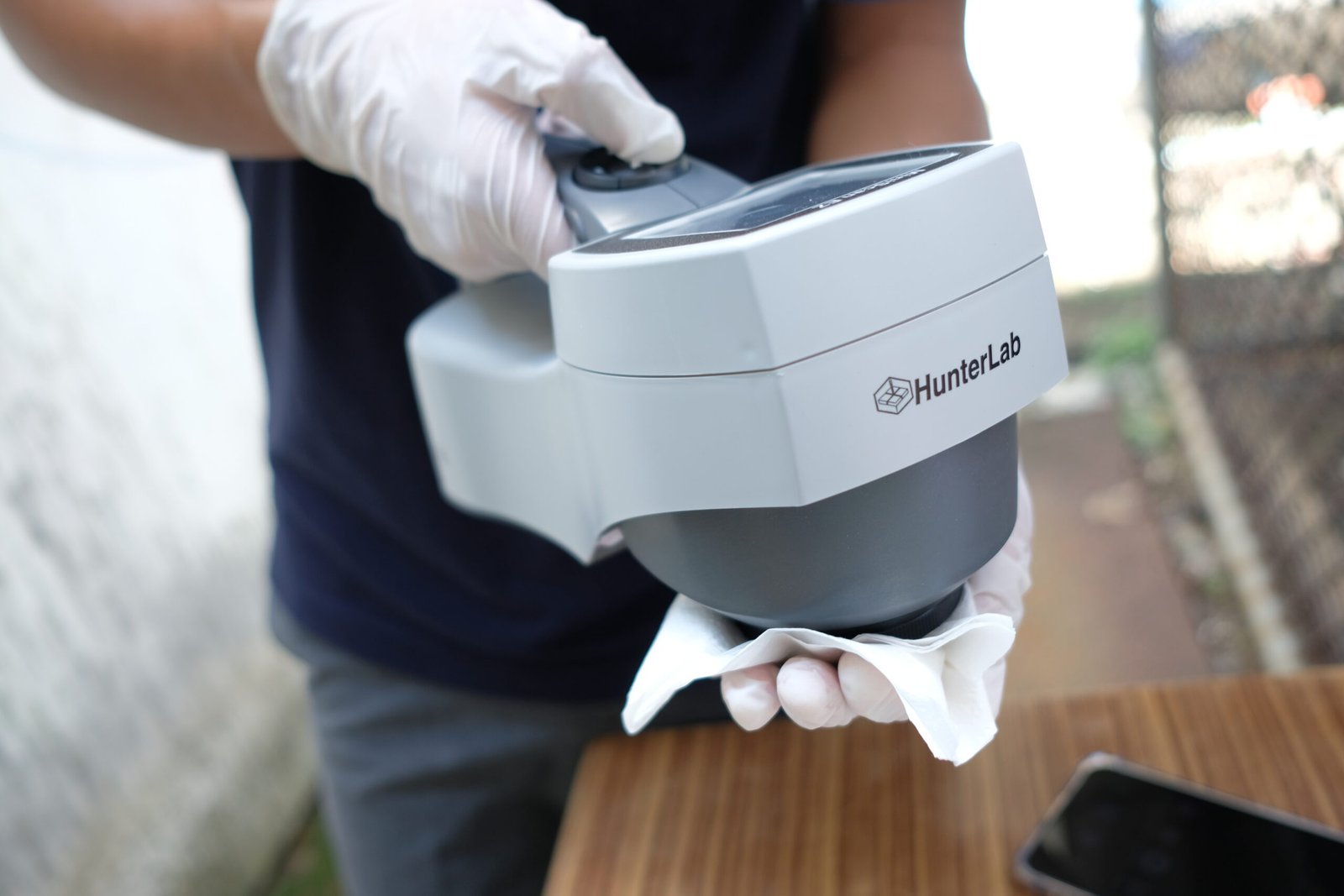
- Cooked shrimp were evaluated at 0, 7 and 14 days by colorimeter, (MiniScan EZ45/0, USA) and visual evaluation by salmon fan score.
RESULTS AND DISCUSSTION
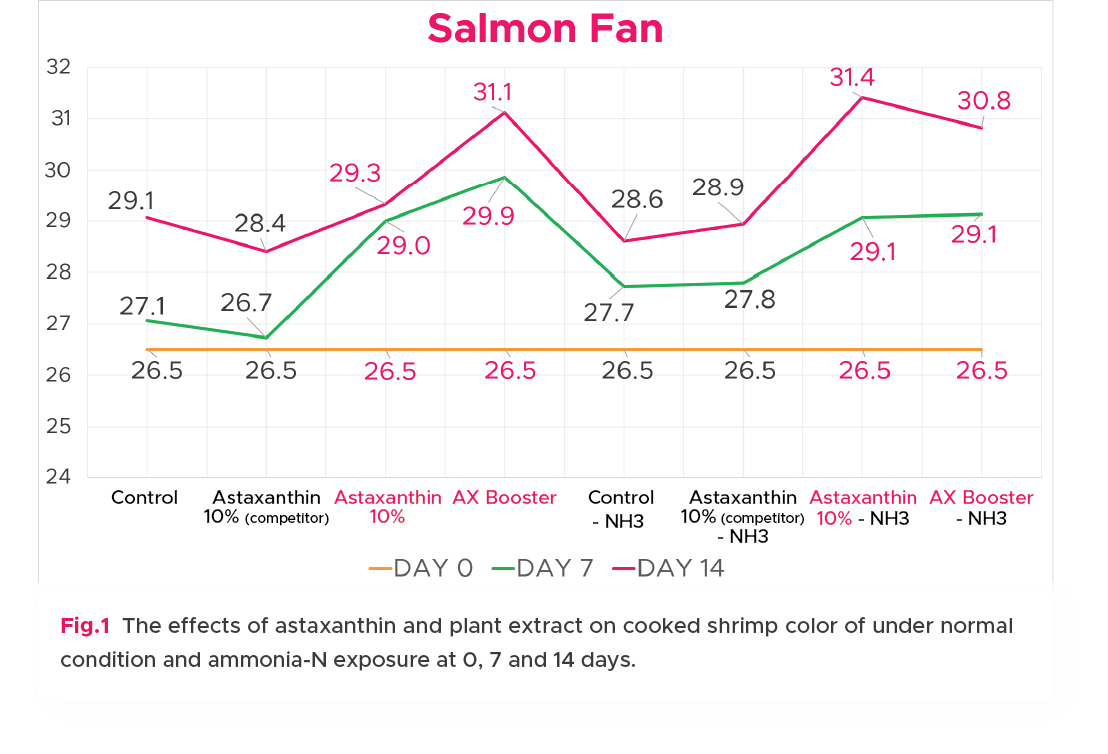
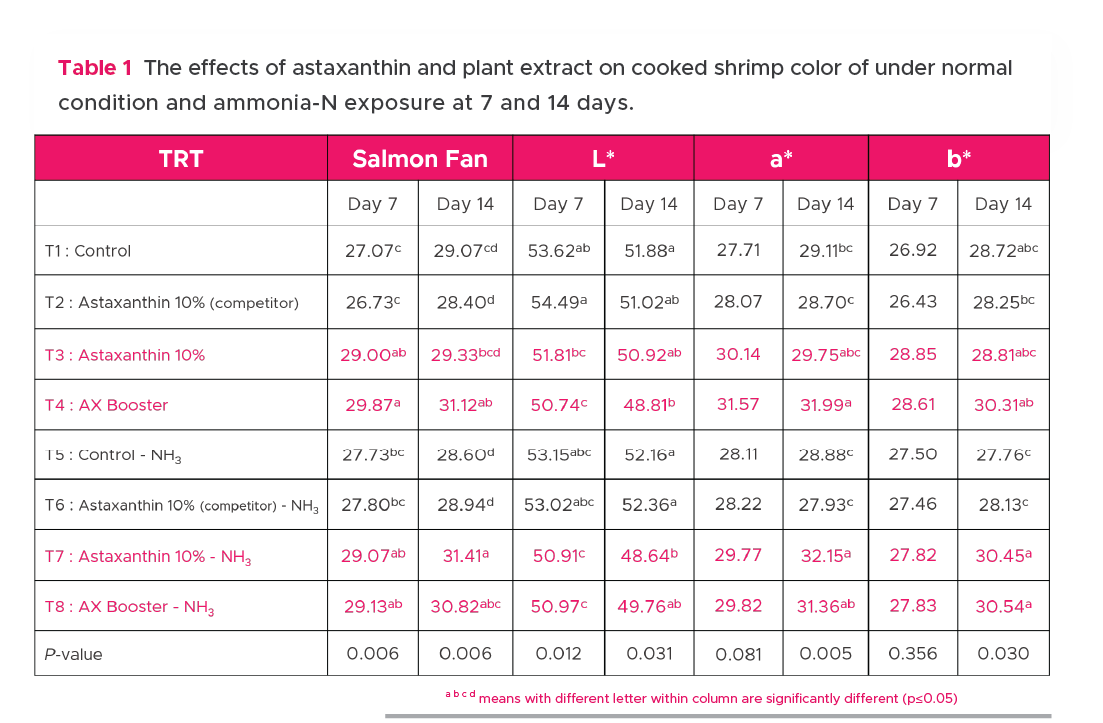
- The cooked shrimp color in black tiger shrimp at day 7 fed diets supplemental T4 was significantly the highest visual color score (29.87, p≤0.05) to the others.
- For a* (redness) and b* (yellowness) at day 7 were not significantly different (p≥0.05) but T7, T8, T3, and T4 tended (p=0.081) to have slightly higher a* than others.
- At day 14, Cooked shrimp score showed T7 had the highest (31.41, p≤0.05) and T2 (28.40), T5 (28.60) and T6 (28.94) had the lowest (p≤0.05) visual color score to others. In addition, visual color score by salmon fan was associated with L* a* and b*
- These can imply that AX booster had the ability to be antioxidant to protect carotenoids from oxidation and stress.
CONCLUSION
- The effect of astaxanthin and plant extract supplementation on cooked black tiger prawn color in normal and ammonia-N stress tests showed that AX booster (T4, T8) demonstrated the cooked shrimp color close to Astaxanthin 10% (T3, T7).
ACKNOWLEDGEMENT
- We would like to thank Kidchakan Supamattaya Aquatic Animal Health Research Center, Faculty of Natural Resources, Prince of Songkla University, Thailand for raw materials and research facility support.
REFERENCES
- Chien, Y., Pan, C., and Hunter, B. 2003. ”The resistance to physical stresses by Penaeus monodon juveniles fed diets supplemented with astaxanthin.” Aquaculture., 216 : 177-191.